The Opera Game
Paul Morphy (White) vs. Duke Karl of Brunswick & Count Isouard (Black) · Paris Opera House (Casual) (1858) · Philidor Defense
Played in a private box during a performance of 'The Barber of Seville,' Morphy's 17-move masterpiece teaches rapid development, open files, and piece sacrifice like no other game in history.
Interactive Demonstration
Paul Morphy vs. Duke Karl of Brunswick & Count Isouard (1858)
Paris Opera House (Casual) · ECO C41 Philidor Defense · Result 1-0
Decisive Turning Points
Annotated Key Moments
- 1. e4: 1. e4 - Morphy claims the center immediately and opens diagonals for his queen and light-squared bishop.
- 2... d6: 2... d6 - The Philidor Defense. Solid, yet notice how it hems in Black's dark-squared bishop on f8.
- 3. d4: 3. d4! - Immediately challenges Black's center and opens lines while Black is cramped.
- 3... Bg4: 3... Bg4? - A classic beginner inaccuracy: pinning the knight too early surrenders the bishop pair or central control.
- 4. dxe5: 4. dxe5! - Forces Black's hand; capturing 4...dxe5?? would drop a pawn after 5. Qxd8+ Kxd8 6. Nxe5.
- 5. Qxf3: 5. Qxf3 - White recaptures with development, already aiming down the f-file toward f7.
- 6. Bc4: 6. Bc4 - Develops a second piece with tempo, threatening 7. Qxf7# checkmate.
- 7. Qb3: 7. Qb3! - A classic double attack targeting both f7 and the undefended b7-pawn.
- 7... Qe7: 7... Qe7 - Forced to save f7, yet the queen now traps Black's f8-bishop and delays castling indefinitely.
- 8. Nc3: 8. Nc3 - Look at Morphy's restraint: instead of greedily grabbing 8. Qxb7 (which allows 8...Qb4+ trading queens), he simply develops another piece!
- 9. Bg5: 9. Bg5 - Every minor piece is now developed into an active pin.
- 10. Nxb5: 10. Nxb5!! - The decisive positional sacrifice: Morphy gives a knight for two pawns solely to keep Black's king stranded in the center.
- 11. Bxb5+: 11. Bxb5+ - Pins the d7-knight immediately.
- 12. O-O-O: 12. O-O-O! - Castling queenside shelters White's king AND swings the rook straight onto the open d-file with lethal force.
- 13. Rxd7: 13. Rxd7! - Eliminates a defender and renews the deadly pin along the d-file.
- 14. Rd1: 14. Rd1! - Brings White's LAST piece, the h1-rook, into the attack. Notice Black's h8-rook and f8-bishop have never moved!
- 15. Bxd7+: 15. Bxd7+ - Strips away another defender around Black's king.
- 16. Qb8+: 16. Qb8+!! - An immortal queen deflection sacrifice forcing Black's final knight off the d-file.
- 17. Rd8#: 17. Rd8# - Checkmate! The purest textbook demonstration of classical chess principles ever played.
Opening Theory Studied Here
C41 · Philidor Defense Complete Guide →Verified Companion Book
Silman's Complete Endgame Course - IM Jeremy Silman
Siles Press · ISBN 1890085103
Purchase Book on AmazonFIDE-Verified Algebraic Scoresheet
Complete Game PGN
[Event "Paris Opera House (Casual)"]
[Date "1858.??.??"]
[White "Paul Morphy"]
[Black "Duke Karl of Brunswick & Count Isouard"]
[Result "1-0"]
[ECO "C41"]
[Opening "Philidor Defense"]

1. e4 e5 2. Nf3 d6 3. d4 Bg4 4. dxe5 Bxf3 5. Qxf3 dxe5 6. Bc4 Nf6 7. Qb3 Qe7 8. Nc3 c6 9. Bg5 b5 10. Nxb5 cxb5 11. Bxb5+ Nbd7 12. O-O-O Rd8 13. Rxd7 Rxd7 14. Rd1 Qe6 15. Bxd7+ Nxd7 16. Qb8+ Nxb8 17. Rd8# 1-0
Featured Masters in This Encounter
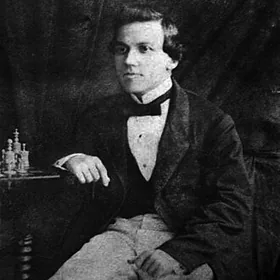
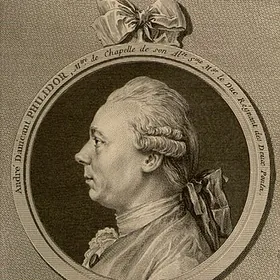
François-André Danican Philidor
Foremost Master of the 18th Century · Author of Analyse du jeu des Échecs (1749)
More Classic Games to Study Next
The Immortal Game
Adolf Anderssen vs. Lionel Kieseritzky
Played in London during Howard Staunton's landmark 1851 International Tournament, Anderssen sacrificed a bishop, both rooks, and his queen to checkmate with three minor pieces.
Turochamp vs. Alick Glennie (First Chess Program Game)
Turochamp (Alan Turing) vs. Alick Glennie
The historic first complete game ever played by a chess algorithm. Because no computer in Manchester could yet execute his program, Alan Turing hand-simulated every move of 'Turochamp' on paper against his colleague Alick Glennie.
Staunton's English Opening in Paris
Howard Staunton vs. Pierre Charles Fournier de Saint-Amant
The clinching final game of Howard Staunton's celebrated 1843 Paris match against French champion Saint-Amant, popularizing 1. c4 across Europe and giving the English Opening its enduring name.