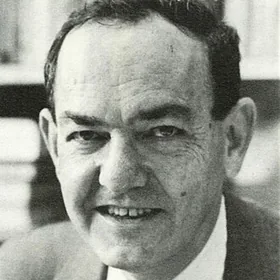
Herbert A. Simon
Nobel Laureate, Turing Award Winner & Chess Cognition Pioneer
Nobel Laureate and Turing Award winner Herbert A. Simon co-created the 1958 Newell-Shaw-Simon (NSS) chess program and pioneered the cognitive science of chess mastery. Alongside William Chase, Simon demonstrated that grandmasters recognize tens of thousands of recurring board patterns ("chunks") rather than calculating blindly.
Portrait: Rochester Institute of Technology · Public domain
Interactive Demonstration
Kaissa vs. Ostrich (1st World Computer Championship) (1974)
Kaissa (USSR) vs. Ostrich (USA) · 1st World Computer Chess Championship, Stockholm (Round 4) · ECO D02 (1-0)
Strategic Portrait
Playing Style & Contribution
Bounded rationality, pattern chunking, and goal-directed selective chess search.
Verified Career Milestones
- 1958: Co-developed the Newell-Shaw-Simon (NSS) chess program at Carnegie Tech, introducing goal-directed search.
- 1973: Published landmark chess-memory studies with William Chase proving master strength stems from structured pattern recognition.
- 1975 & 1978: Awarded the ACM Turing Award (with Allen Newell) and the Nobel Memorial Prize in Economic Sciences.
Practical Application
Lessons You Can Apply Today
- Build a mental library of recurring chess patterns (back-rank mates, minority attacks, Lucena bridges) rather than trying to calculate every game from scratch.
- Human cognition works best through bounded rationality: pick clear positional goals like king safety or central control to narrow your candidate moves.
- Study annotated master games actively so key piece-coordination motifs become instant visual chunks.
Essential Reading
The Sciences of the Artificial (3rd Edition) - Herbert A. Simon
The MIT Press · ISBN 0262691914
Purchase Book on AmazonSignature Openings Studied by Herbert A. Simon
Contemporaries & Era Peers
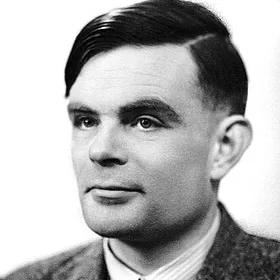
Alan Turing
Minimax tree search, positional heuristics, and the foundational idea of quiescence evaluation.
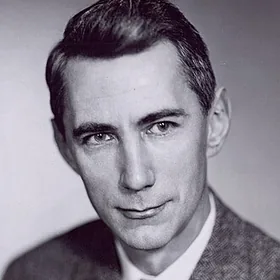
Claude Shannon
Evaluation functions, minimax search, and Type-A brute-force vs. Type-B selective search architecture.
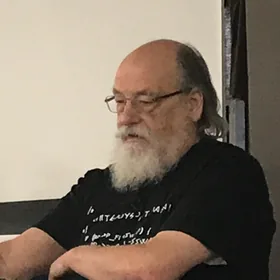
Ken Thompson
Dedicated move-generation hardware, transposition tables, and complete retrograde endgame tablebases.