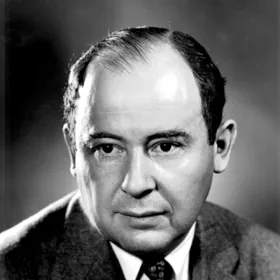
John von Neumann
Author of the Minimax Theorem (1928) & Stored-Program Architecture
Hungarian-American polymath John von Neumann proved the 1928 Minimax Theorem and co-authored Theory of Games and Economic Behavior (1944), establishing the mathematical foundation for adversarial tree search. His stored-program computer architecture also powered the Los Alamos MANIAC I, which played the first complete machine-executed chess game in 1956.
Portrait: LANL · Attribution
Interactive Demonstration
Turochamp vs. Alick Glennie (First Chess Program Game) (1952)
Turochamp (Alan Turing) vs. Alick Glennie · Manchester, United Kingdom · ECO C28 (0-1)
Strategic Portrait
Playing Style & Contribution
Mathematical game theory, minimax optimality, and foundational digital computing architecture.
Verified Career Milestones
- 1928: Proved the Minimax Theorem, defining optimal decision-making in two-player zero-sum games.
- 1944: Co-authored Theory of Games and Economic Behavior with Oskar Morgenstern at Princeton.
- 1956: Los Alamos scientists ran the first computer-played chess game on the von Neumann-inspired MANIAC I computer.
Practical Application
Lessons You Can Apply Today
- Apply minimax thinking at the board: never judge your move by what you hope your opponent plays, judge it by their strongest possible reply.
- Always assume your opponent sees every refutation you see; sound chess comes from minimizing their maximum counterplay.
- Think in clean forcing trees before committing to irreversible pawn advances or piece sacrifices.
Essential Reading
Theory of Games and Economic Behavior - John von Neumann & Oskar Morgenstern
Princeton University Press · ISBN 0691130612
Purchase Book on AmazonSignature Openings Studied by John von Neumann
Contemporaries & Era Peers

Alan Turing
Minimax tree search, positional heuristics, and the foundational idea of quiescence evaluation.

Claude Shannon
Evaluation functions, minimax search, and Type-A brute-force vs. Type-B selective search architecture.

Ken Thompson
Dedicated move-generation hardware, transposition tables, and complete retrograde endgame tablebases.